The best time to visit Bali is May to September: this is the dry season, with under 100 mm of rain a month in the south. May, June and September give the best balance of good weather and fewer visitors, while July and August are the busiest months. From November to March it rains often but rarely all day, and the island is quieter. In 2027, Nyepi, the day of silence, falls on Monday 8 March: the airport closes for 24 hours.
Key facts
| Dry season | April to October |
|---|---|
| Wet season | November to March |
| Driest month | August: about 15 mm, 3 rainy days |
| Wettest month | January: about 350 mm, 19 rainy days |
| Temperatures | 24 to 31 °C all year on the coast, sea at 27-29 °C; cooler at about 700 m around Jatiluwih |
| Nyepi 2027 | Monday 8 March 2027, 6am to 6am the next day |
| Peak periods | July-August and 20 December to early January |
When is the best time to go to Bali?
For weather, aim for May to September. Skies are mostly clear, the air is less heavy, and a south-easterly breeze takes the edge off the heat. August is the driest month.
To avoid the crowds without giving up the weather, choose May, June or September. October and April are still good picks, a little more humid. If budget comes first, mid-January to March is the quietest period, provided you accept showers almost every day.
Dry season and wet season: what actually changes?
Bali lies just south of the equator: temperatures barely move, from 24 °C at night to 31 °C by day, and the sea stays between 27 and 29 °C. What changes is rain and humidity.
In the dry season (April to October), the south of the island gets under 100 mm a month and up to ten hours of sunshine a day.
In the wet season (November to March), showers are heavy but often short, mostly in the afternoon or at night, with bright spells in between. The air is muggy, some beaches collect rubbish washed down by rivers, and roads can flood in places. The south (Canggu, Seminyak, Uluwatu) is the least rainy part of the island. Ubud and the mountains get noticeably more.
What is the weather like in Bali month by month?
Averages for 1991-2020 recorded at the airport, near Denpasar. Other datasets give slightly different figures (296 to 350 mm in January, 15 to 53 mm in August): treat these as orders of magnitude.
| Month | Rain | Rainy days | Weather | Crowds |
|---|---|---|---|---|
| January | 350 mm | 19 | Very humid, heavy showers | High in the first days, then low |
| February | 280 mm | 18 | Very humid | Low |
| March | 215 mm | 20 | Frequent, shorter showers | Low, except around Nyepi |
| April | 90 mm | 12 | Transition, drying out | Moderate |
| May | 75 mm | 8 | Dry, sunny | Moderate |
| June | 70 mm | 7 | Dry, slightly cooler | Rising |
| July | 50 mm | 4 | Dry, breezy | Very high |
| August | 15 mm | 3 | Driest | Very high |
| September | 40 mm | 3 | Dry, sunny | Moderate to high |
| October | 90 mm | 6 | Hot, first showers | Moderate |
| November | 150 mm | 10 | Hot and muggy, rain returns | Low |
| December | 290 mm | 16 | Very humid | Low, then very high from the 20th |
The crowd levels are a trend drawn from the guides we consulted, not an official statistic.
When should you surf in Canggu and Uluwatu?
The west coast works in the dry season. From April to October, south-easterly trade winds blow from land to sea on west-facing breaks, and the biggest swells arrive from June to August.
- Uluwatu and the Bukit peninsula: the main season runs from April to October. The waves are powerful and break over reef: this is ground for experienced surfers. /en/bily/, in Bingin, sits in the middle of these breaks.
- Canggu: more accessible. Mornings are best, before the wind turns. From /en/nakula/, in Berawa, you can reach both the gentle waves of Batu Bolong and the more serious peaks.
- Wet season: the wind reverses and the east coast (Sanur, Nusa Dua) takes over. In Canggu the waves are often smaller, which can suit beginners, but the water is murky near rivers after rain.
April, May, September and October combine decent swell with fewer people in the water.
When is the sea calmest for the crossing to Nusa Lembongan?
Fast boats leave Sanur all year and take 30 to 45 minutes depending on the sea. The guides we consulted agree on two points: the sea is generally calmer from May to September, and rougher in the wet season, especially in January and February.
The dry season is no guarantee, though. The big swells of July and August, when they coincide with a high tide, can also make the crossing rough or cancel it, sometimes at short notice. We found no official figures on cancellations by month: check with the boat company the day before.
Three useful habits: take a morning boat, as the sea often picks up in the afternoon. Keep a night in hand on Bali before an international flight. And note that the last boat to reach /en/django/, on Jungutbatu beach, leaves Sanur at 5pm. The details are in our article on getting to Nusa Lembongan from Sanur.
What is the weather like in the highlands around Jatiluwih?
The figures in the table apply to the south coast. The Jatiluwih rice terraces, at the foot of Mount Batukaru, sit at about 700 m above sea level. The air is noticeably cooler than in the south of the island, especially early in the morning and in the evening, and it rains more often, including in the dry season. We found no official temperature or rainfall record for the village: expect it to be a few degrees cooler than Canggu or Uluwatu, with no precise figure.
Mist and low cloud often rise in the afternoon and can hide the view. Aim to be there between 8am and 10am. On top of your beach clothes, pack:
- a light rain jacket or an umbrella, in any season;
- a long-sleeved layer for evenings and early mornings;
- shoes that grip on damp paths.
The rice seasons. There is no single calendar: planting and harvest dates are set by each subak, the irrigation cooperative, and plots are staggered from one another. Published guidance differs:
- wet-season rice is planted between November and March or April and harvested three to four months later, so from February to June according to one guide;
- the terraces are most often described as greenest from February to April;
- the same guide places the harvest you can watch on site in June and July, while another recommends February to May, then September to early November, to see fully grown rice.
After a harvest, plots stay bare or flooded for a few weeks: the landscape is still beautiful, but less green. If the colour of the paddies matters to you, ask your host about the state of the terraces before fixing your dates. Check before you travel.
Our guide to Jatiluwih covers access, walking trails and where to stay today. /en/moringa/, our future place in Jatiluwih, is not open yet: it is opening soon, with no date announced.
Nyepi 2027: what date, and what closes?
Nyepi is the Balinese New Year, a day of complete silence. In 2027 it falls on Monday 8 March, the date set in Indonesia's official public holiday calendar. The silence lasts 24 hours, from 6am on Monday to 6am on Tuesday 9 March.
During those 24 hours:
- nobody goes out on the streets or the beach, tourists included, and you stay inside your hotel or villa;
- Ngurah Rai airport is closed, with no take-offs or landings. The official notice for 2027 had not been published as of 25 November 2026, but the closure applies every year;
- ports are closed and no fast boats run. In 2026 they closed from 5pm the day before. Nusa Lembongan observes Nyepi too;
- shops and restaurants are closed, cash machines may not work, and lights are kept low;
- mobile internet has been switched off in some years: check for 2027.
The evening before, parades of ogoh-ogoh, large demon effigies, fill the villages. Do not arrive or leave on 8 March, shop for food the day before, and tell your host your plans.
One 2027 detail: Eid al-Fitr is set for 10 and 11 March, with collective leave days around it. Many Indonesians will be on holiday until 15 March, and Bali will be busier than usual at that time. The Eid date may still shift by a day.
When are the peak periods, and how early should you book?
Two peaks stand out: July and August, with European and Australian school holidays, and 20 December to early January. Easter and the Indonesian holidays after Ramadan create shorter spikes.
Orders of magnitude given by rental agencies:
- July and August: book at least three months ahead;
- Christmas and New Year: four to six months ahead, and up to nine to twelve months for large villas or beachfront;
- in these periods, many places require a minimum stay of three to five nights;
- the rest of the year, a few weeks is usually enough.
Homes that sleep eight are the first to go. Before booking flights, also check the formalities in our article on visa, tourist tax and money in Bali.
Frequently asked questions
Does it rain all day in the wet season?
Rarely. Showers are heavy but often short, mostly in the afternoon or at night. January and February can still bring several grey days in a row.
Is Bali cold in July and August?
No. Nights drop to about 23 or 24 °C on the coast and days stay around 29 °C. It is cooler in the mountains.
Can you land in Bali on Nyepi?
No. The airport closes for 24 hours, from 6am on Nyepi to 6am the next day. In 2027, avoid any arrival or departure on Monday 8 March.
What is the cheapest month to visit Bali?
February, March outside the Nyepi period, and November are generally the quietest and therefore cheapest months, according to the guides we consulted. We give no figures, as they vary too much.
Is September a good month for Bali?
Yes. It rains on about three days in the month, the swell is still good for surfing and there are fewer people than in August.
Is Jatiluwih cooler than the coast?
Yes. The rice terraces sit at about 700 m: the air is cooler, especially in the morning and evening, and it rains more often than in the south. Pack a rain jacket and a long-sleeved layer. We have no official record to give a figure.
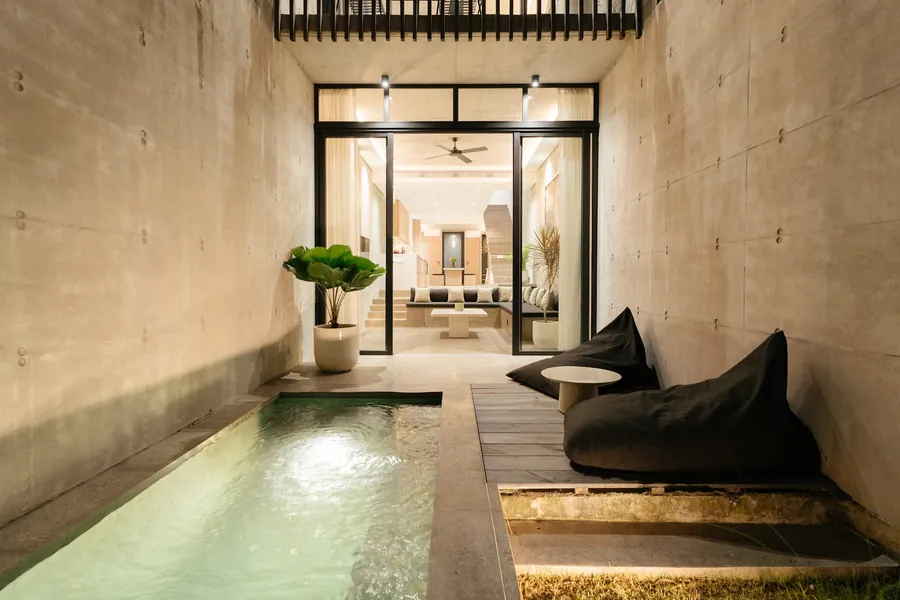
Where to stay · Berawa, Bali
Villa Nakula
A private pool villa by the river, in the heart of Berawa.
DiscoverInformation checked on 25 November 2026. Sources : Climates to Travel, Bali climate (1991-2020 averages at the airport), Weather2Travel, Denpasar climate, Indonesian State Secretariat, joint ministerial decree on 2027 public holidays, Kompas, full list of 2027 national holidays and collective leave, Bali.com, Nyepi guide (rules, closures, upcoming dates), The Bali Sun, airport, road and port closures during Nyepi, Bali.com, Canggu surf guide (seasons and winds), Indonesian Surf Guide, dry season surf in Bali, The Lembongan Traveller, fast boat to Nusa Lembongan, The Jakarta Post, bad weather halts fast boat services (July 2018), Virgin Australia, best time to visit Bali (high seasons), Bali Villa Hub, peak season in Bali (booking lead times), Bali.com, Jatiluwih rice terraces (altitude, rain, rice calendar, best time of day), Sunshine Seeker, best time to visit Jatiluwih (cooler than the south, greenest months).