Jatiluwih is a village in Tabanan regency, central Bali, known for rice terraces that were inscribed on the UNESCO World Heritage List in 2012 together with the subak irrigation system. It is about 1.5 hours by road from Canggu or Ubud, entry costs IDR 75,000 to 100,000 depending on the source (about €3.70 to €5), and marked trails give you a walk of 30 minutes to 4 hours. Go early in the morning: it is cooler than the coast, and cloud often builds in the afternoon.
Key facts
| UNESCO inscription | 2012, "Cultural Landscape of Bali Province: the Subak System", five sites, about 19,500 hectares |
|---|---|
| Altitude | About 700 m, at the foot of Mount Batukaru (2,276 m) |
| Entrance fee (foreign adult) | IDR 75,000 or IDR 100,000 depending on the source (about €3.70 to €5), check on arrival |
| Trails | Five colour-coded routes, from 1.5 km (30 to 45 minutes) to 5.5 km (3.5 to 4 hours) |
| From Canggu or Ubud | 40 to 46 km, about 1.5 hours |
| From the airport | 55 to 60 km, 1.5 to 2 hours |
| Temperatures | 22 to 27°C by day, 18 to 20°C at night, according to one guide |
What is Jatiluwih and why did UNESCO list it?
Jatiluwih is a farming village whose rice terraces step down the slopes of Mount Batukaru. It is not a set built for visitors: rice is grown here, and the landscape changes with the crop cycle.
In 2012 UNESCO inscribed the "Cultural Landscape of Bali Province: the Subak System as a Manifestation of the Tri Hita Karana Philosophy" on the World Heritage List. The property covers five sites and about 19,500 hectares. Jatiluwih belongs to the largest of them, the subak landscape of Catur Angga Batukaru, whose terraces are mentioned in a 10th-century inscription according to UNESCO.
A subak is an irrigation cooperative: farmers share water through a network of canals, tunnels and weirs, and decisions are organised around water temples. The system dates back to the 9th century. Tri Hita Karana is the idea of balance between the spiritual world, people and nature.
Where is Jatiluwih and how do you get there?
Jatiluwih is in Tabanan regency, in the centre of the island, at about 700 m above sea level. The times below come from travel guides, not from an official measurement, and vary with traffic.
| From | Distance | Drive time |
|---|---|---|
| Canggu | 40 to 46 km | About 1.5 hours |
| Ubud | 40 to 45 km | 1 hour 15 to 1.5 hours, up to 2 hours |
| Ngurah Rai airport | 55 to 60 km | 1.5 to 2 hours |
| Sanur | 50 to 52 km | 1 hour 45 to 2 hours |
| Uluwatu | About 75 km | 2.5 to 3 hours |
There is no public transport, and Grab and Gojek drivers rarely accept the trip, especially for the return. The simplest option is a driver for the day who waits for you. A scooter is possible for experienced riders: the road is good at first, then narrower, steeper and winding, and fog or rain can arrive quickly.
From Canggu it works well as a day trip: it is about 1.5 hours from Villa Nakula, our home in Berawa, for example.
How much is the entrance fee and which trail should you pick?
You pay at a checkpoint on the road, even if you are only driving through or staying in the village. Sources disagree on the 2026 price: IDR 75,000 per foreign adult and IDR 50,000 per child according to The Bali Sun (January 2026), IDR 100,000 according to a guide updated in July 2026. That is about €3.70 to €5. Older pages still show IDR 40,000 to 50,000. Bring cash, expect a small parking charge, and check the price on arrival.
Opening hours also differ between guides: 6am to 7pm in one, 8.30am to 6pm in another. The site is not fenced.
A guide published in November 2026 describes five colour-coded trails:
- Red: 1.5 km, 30 to 45 minutes.
- Purple: 2 km, 1 to 1.5 hours.
- Yellow: 2.3 km, 1 to 2 hours.
- Blue: 3.1 km, 1.5 to 2 hours.
- White: 5.5 km, 3.5 to 4 hours, also open to bicycles.
These lengths are approximate, and some visitors also mention an orange route: rely on the map displayed at the entrance. The red trail is enough to see the terraces. The blue and white trails drop further, so they climb on the way back, and the furthest stretches are less well maintained.
What is the best time of day and of year?
On the time of day, sources agree: the morning, between 8am and 10am. Tour groups arrive around midday, and in the afternoon mist and low cloud can hide the view.
On the season, they contradict each other. Bali.com recommends February to April, when the rice is green then yellow, and places the local harvest in June and July. Another guide prefers May to July. Others advise against June to August, when harvested plots are muddy or bare. The dry season, roughly April to October, has the most settled weather. November to March is quieter, but the paths are slippery.
In practice, planting is staggered and no date is guaranteed: ask your host or look at recent photos before you go. For the island's weather month by month, see our article on the best time to visit Bali.
What is the weather like in Jatiluwih and what should you pack?
Altitude changes everything: one guide gives 22 to 27°C by day and 18 to 20°C at night, clearly lower than on the coast. It also rains more often, including in the dry season.
- Closed shoes that can cope with mud.
- A light rain jacket or an umbrella.
- A jumper or hoodie for the evening if you stay overnight.
- A hat and sunscreen: the trails are in the open.
- Water, insect repellent and cash, as cards are rarely accepted.
What else is there to see near Jatiluwih?
- Mount Batukaru (2,276 m), Bali's second-highest peak after Agung. The climb is a forest trek, best done with a guide.
- Pura Luhur Batukaru, a temple on the mountain's southern slope, a short drive away. Sources differ on the drive time and on the fee, from a free donation to IDR 40,000 (about €2). A sarong and sash are required and available at the gate.
- Angseri hot springs, on the way to Jatiluwih, with a small waterfall next to them.
- Yeh Hoo waterfall, in the same Penebel district.
- Ulun Danu Beratan temple, in Bedugul, 40 to 60 minutes away according to tour schedules.
We found no reliable drive time for Angseri or Yeh Hoo: check a map before you set off.
Day trip, or one or two nights on the spot?
Most visitors spend 2 to 4 hours in Jatiluwih. With a 3-hour round trip from Canggu or Ubud, that fills a day, often combined with Bedugul.
Staying one or two nights has a real benefit: you are in the rice fields at first light, before the coaches, with time for the temple and the hot springs. Beyond two nights, you need to enjoy quiet.
Where to stay today. The choice is small: guesthouses, eco-lodges, family-run stays and a few mountain tent camps, with no large hotels. Check that you can have dinner on site or within walking distance, that the room has hot water and blankets, and whether a transfer can be arranged. Prices are often lower in the rainy season.
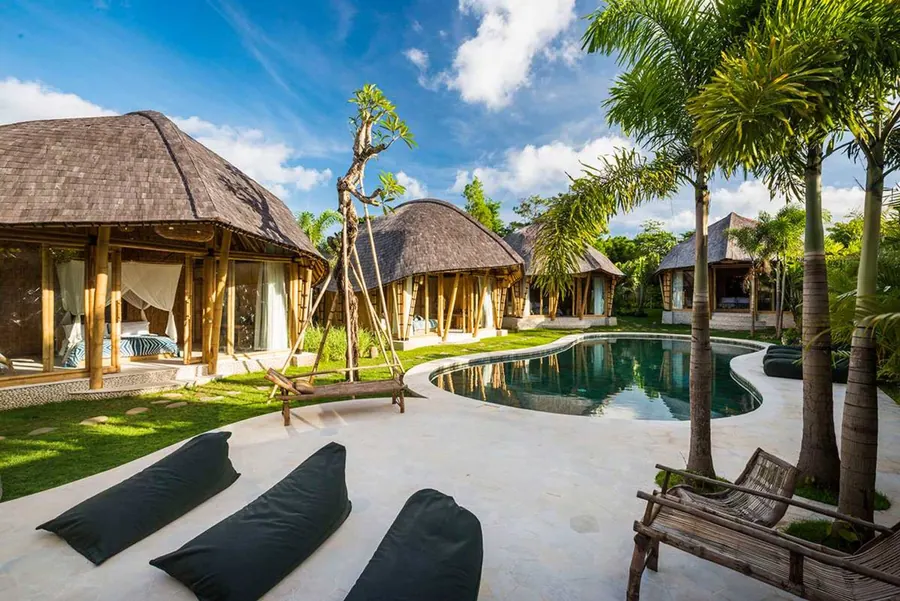
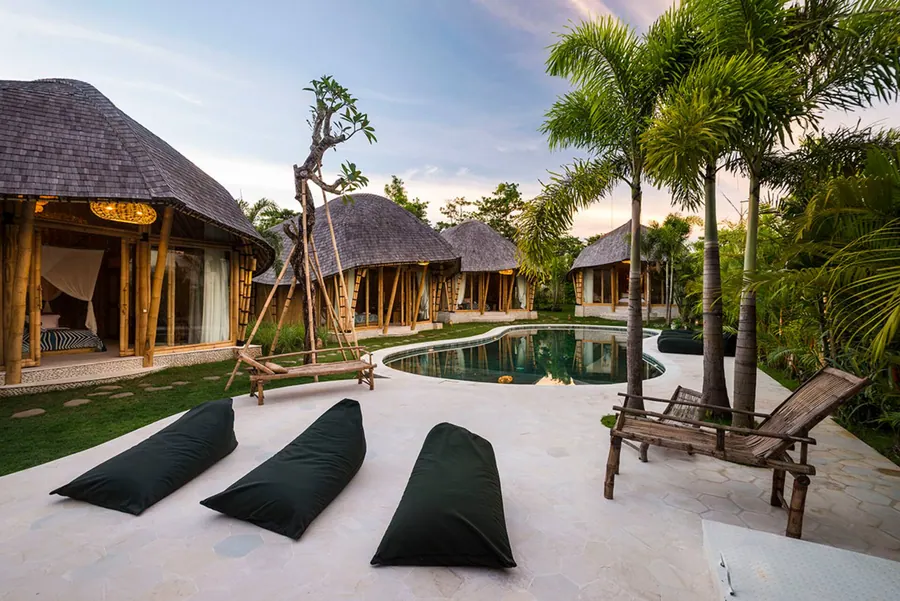
Our address, opening soon. Moringa is our project in Jatiluwih, at the foot of Mount Batukaru. It is not open yet, has no opening date and cannot be booked today. The plan is a small estate on half a hectare, with up to eight wooden bungalows, each with a private sauna and a cold plunge, and a restaurant of about 16 seats. All of this may still change. To fit the stop into a trip, see our 10-day Bali itinerary, which ends in Jatiluwih.
What are the downsides to know about?
- The weather. Frequent rain and afternoon cloud: a clear view is never guaranteed.
- The journey. A narrow road at the end, no public transport, and a difficult return without a driver.
- The landscape varies. After the harvest, the terraces are brown and muddy.
- Few services. A handful of restaurants, no nightlife, cash payments. For cash, see our article on visas, the tourist tax and money in Bali.
- The trails. Some visitors report dogs and poorly marked hazards on the white route.
- A site under pressure. In December 2025 the authorities sealed 13 restaurants and shops built in the rice fields, and farmers put up metal sheets in protest. An agreement was reached in early January 2026, the sheets were removed and the site stayed open.
Frequently asked questions
How long do you need to visit the Jatiluwih rice terraces?
Allow 2 to 4 hours on site, depending on the trail and a lunch stop. The shortest route takes 30 to 45 minutes.
Jatiluwih or Tegalalang: which rice terraces should you choose?
Jatiluwih is far larger and, according to guides, much less crowded than Tegalalang near Ubud. Tegalalang is quicker to reach from Ubud, while Jatiluwih is better for a proper walk.
Can you visit Jatiluwih without a guide?
Yes. The trails are colour-coded and a map is displayed at the entrance. A local guide is useful if you want to understand how the subak work.
Can you fly a drone at Jatiluwih?
Some areas ban drones or require local permission. Ask at the ticket office before taking off.
Can you already book Moringa?
No. Moringa is not open yet and has no opening date or price. In the meantime, choose a guesthouse or eco-lodge in the village, or come for the day.
Is Jatiluwih suitable for children?
The short trail is easy and in the open. Pushchairs struggle on the field paths, and the winding road can be hard on children prone to travel sickness.

Where to stay · Jatiluwih, Bali
Moringa
A small estate of wooden bungalows at the foot of Mount Batukaru, near the rice terraces of Jatiluwih. Opening soon.
DiscoverInformation checked on 25 November 2026. Sources : UNESCO World Heritage Centre, Cultural Landscape of Bali Province: the Subak System as a Manifestation of the Tri Hita Karana Philosophy, UNESCO World Heritage Committee, decision 36 COM 8B.26 (inscription, 2012), Wikipedia, Subak (irrigation), Bali Holiday Secrets, Jatiluwih travel guide (updated July 2026), Bali Holiday Secrets, Jatiluwih rice terraces (updated July 2026), The Bali Sun, Jatiluwih visits, protest and 2026 entry fee (January 2026), TripTins, Jatiluwih rice terraces trails (November 2026), Bali.com, Jatiluwih rice terraces, Wikipedia, Pura Luhur Batukaru, Pickyourtrail, Pura Luhur Batukaru, Love Bali (Bali provincial government), Angseri hot springs, Bali.live, Jatiluwih dispute: sealed restaurants and farmers' protest, Klook, Ulun Danu Beratan and Jatiluwih day trip schedule, Exchangerate.guru, EUR to IDR (mid-November 2026, about 20,200 Rp per euro).